










Blog
How technical data, testing methods, and material properties translate into real project outcomes — from specification to long-term performance
Marble Performance in Practice
Material selection is rarely a purely aesthetic decision. For architects and engineers, the challenge lies in aligning design intent with technical reliability — ensuring that what is specified will perform under real project conditions.
Marble, like all natural materials, varies. Its performance is not defined by appearance, but by measurable properties — each of which directly influences durability, behavior, and risk.
Understanding marble technical properties is not about reading a datasheet. It is about anticipating how the material will perform once installed.
CLADDING PROJECT IN MOSCOW | SAVVIN RIVER RESIDENCE
What Challenges Are Most Common When Specifying Marble?
- Uncertainty about long-term performance
- Surface wear appearing sooner than expected
- Material behaving differently depending on application
In most cases, they relate to how marble is evaluated, selected, and applied.
Marble is not defined only by its visual characteristics. Its performance is determined by a set of measurable properties — each of which plays a role in how the material behaves once installed.
Understanding these properties allows for more controlled decisions, especially in projects where scale, complexity, and durability are critical.
Why Technical Data Matters in Marble Specification
Common challenges include:
- Surface wear in high-traffic areas
- Staining or moisture-related issues in wet environments
- Breakage in large-format or thin applications
- Inconsistency across large-scale projects
They are often predictable — and preventable — when marble technical data is properly understood and applied.
How Marble Performance Is Measured (EN & ASTM Standards)
These tests simulate controlled conditions to evaluate how marble behaves under:
- Load
- Moisture exposure
- Mechanical stress
- Surface wear
Key Testing Standards (EN & ASTM)
- Apparent Density / Bulk Properties
EN 1936
Corresponding ASTM C97/C97M – absorption & bulk specific gravity - Water Absorption
EN 13755
ASTM C97/C97M - Compressive Strength
EN 1926
ASTM C170/C170M - Flexural Strength
EN 12372
ASTM C880/C880M, also ASTM C99/C99M depending on specification approach - Abrasion Resistance
EN 14157
ASTM C241/C241M, ASTM C1353/C1353M - Freeze–Thaw Resistance
EN 12371
ASTM C666/C666M, ASTM C1645 in durability evaluation frameworks
However, test results indicate potential performance, not guarantees.
Final performance depends on:
- Quarry selection
- Block quality
- Cutting direction
- Application and detailing
Beyond Testing: Specification & Selection Standards
Beyond individual test methods, marble specification and selection are also guided by broader standards and industry frameworks.
These are particularly relevant in international projects, where alignment between European and American specifications is required.
Key references include:
- ASTM C503/C503M
Standard Specification for Marble Dimension Stone
→ Defines classification and suitability criteria for marble - ASTM C1528/C1528M
Guide for Selection of Dimension Stone
→ Links material properties with application, exposure, fixing methods, and performance expectations - ASTM C1378
Resistance to Staining
→ Critical for kitchens, bathrooms, and high-use surfaces - ASTM C650
Resistance to Chemical Substances
→ Relevant for maintenance, cleaning products, and long-term surface behavior - ASTM C1823/C1823M
Shear Bond Strength of Adhered Stone
→ Important for adhered systems and installation reliability - ASTM C1721
Petrographic Examination
→ Provides insight into the internal structure and mineral composition of the stone
These standards reinforce an important principle:
Material performance is not defined only by isolated test values, but by how these values relate to application, detailing, and long-term behavior.
Key Marble Properties and What They Mean for Your Project
Apparent Density
Indicates material compactness and internal structure
Typically evaluated under EN 1936, with related parameters referenced in ASTM C97/C97M for bulk specific gravity and absorption
- Typical range: 2.55 – 2.75 g/cm³
- Higher density:
- improved durability
- better polish retention
- Lower density:
- increased porosity risk
- higher sensitivity in demanding environments
Critical for high-use areas, exterior applications, and long-term performance.
Defines how much moisture the marble can absorb.
Typically evaluated under EN 13755 or ASTM C97/C97M
- Typical range: 0.1% – 0.8%
- <0.2%:
- suitable for demanding environments
- 0.5%:
- requires careful application consideration
Essential for exterior marble, façades, pools, bathrooms, and wet areas.
Higher absorption increases risk of staining, freeze–thaw damage, and long-term degradation.
Compressive Strength
Measures resistance to load and crushing forces
Typically evaluated under EN 1926 or ASTM C170/C170M
- Typical range: 70 – 140 MPa
Relevant for flooring, structural elements, and high-load environments such as hotels, commercial spaces, and public areas.
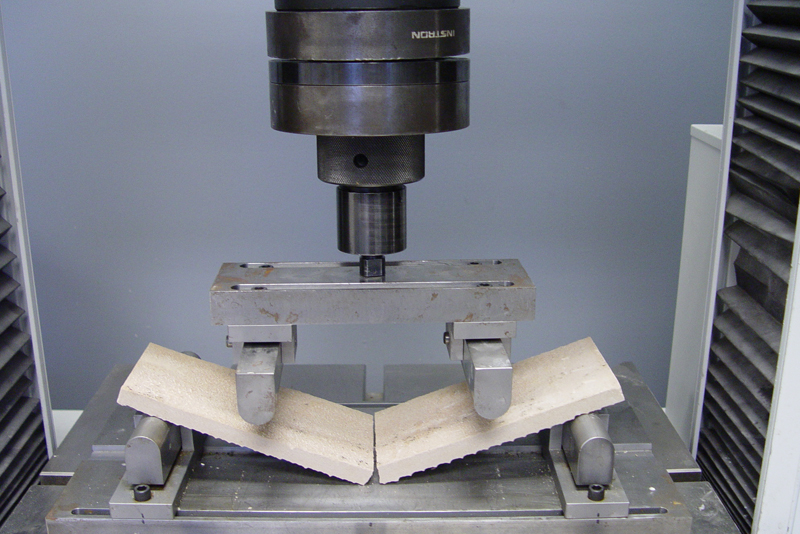
Flexural Strength
Indicates resistance to bending and breaking
Typically evaluated under EN 12372 or ASTM C880/C880M, and in some cases ASTM C99/C99M depending on specification requirements
- Typical range: 7 – 20 MPa
Critical for:
- marble cladding systems
- large-format slabs
- reduced thickness applications
Abrasion Resistance
Defines how marble surfaces respond to wear over time
Typically evaluated under EN 14157 or ASTM C241/C241M and ASTM C1353/C1353M
- Evaluated through standardized abrasion testing
Directly impacts:
- flooring performance
- stair durability
- long-term maintenance
MATERIAL TEST LAB
From Data to Decision
Marble technical properties should not be viewed in isolation.
They must be interpreted in relation to:
- Application type
- Environmental exposure
- Traffic levels
- Design intent (size, thickness, finish)
- A marble suitable for wall cladding may not perform in flooring
- A visually consistent material may vary structurally between blocks
- A low absorption value may be critical in one project and less relevant in another
Marble Applications and Property Mapping
| Application | Key Properties | What to Control |
|---|---|---|
| Exterior | Water absorption, density, frost | Moisture resistance, durability |
| Wet areas | Water absorption, porosity | Staining, long-term stability |
| Cladding / large slabs | Flexural strength | Structural behavior, breakage risk |
| Flooring | Abrasion, compressive strength | Wear, maintenance |
| Surface finish | Density, abrasion, absorption | Finish durability and performance |
5 BLADES CUTTING LINE
The Role of Early Material Involvement
Many marble performance issues arise because material decisions are made too late in the process.
Early-stage involvement allows:
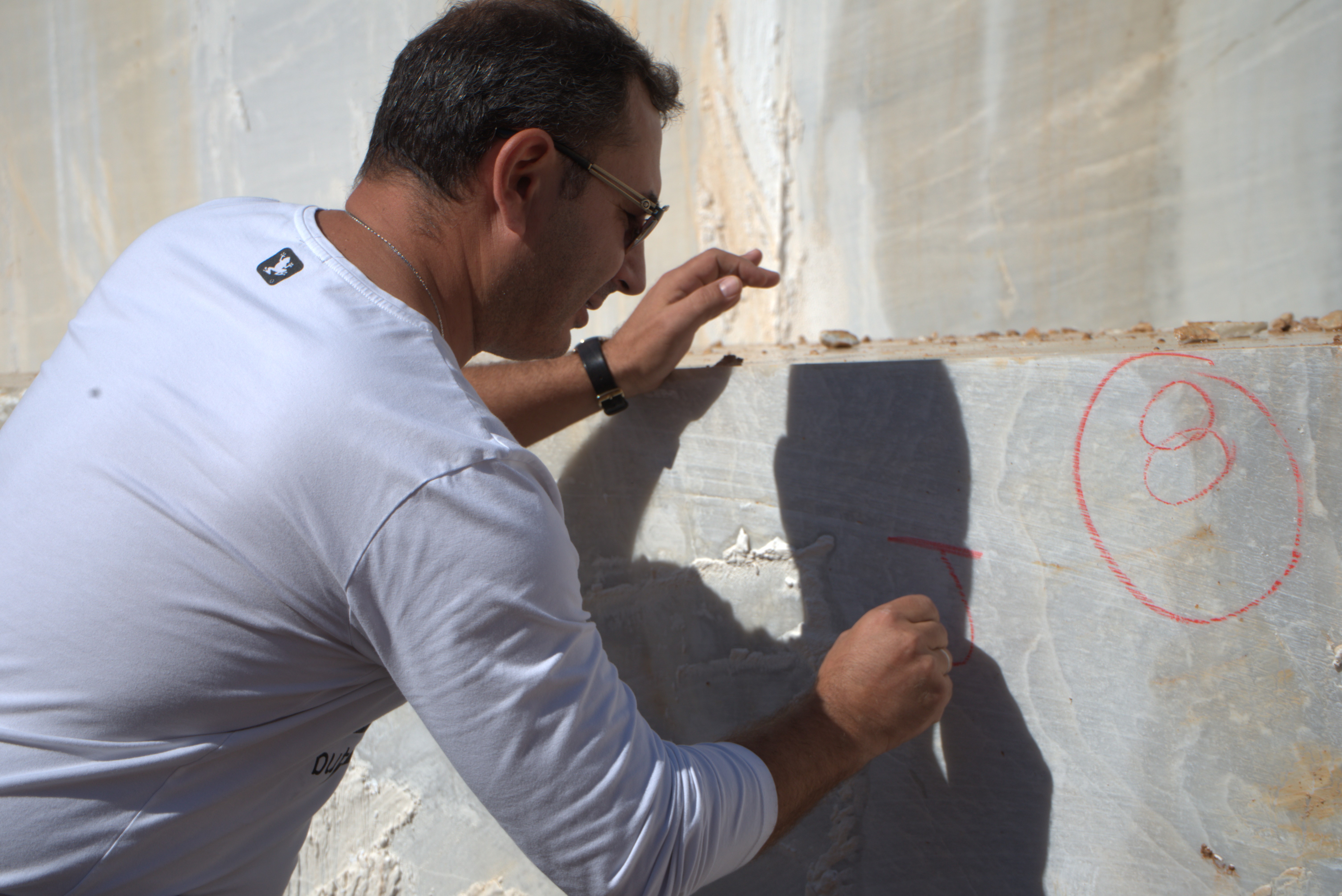
- evaluation at block level
- alignment of material properties with project requirements
- control over consistency and production
- technical risk
- delays
- costly replacements
WALL CLADDING - RECEPTION DESK - FLOORING APPLICATIONS | JW MARRIOTT CRETE
Q&A: Practical Considerations in Marble Specification
How important are international standards (EN vs ASTM) in marble specification?
In international projects, both EN and ASTM standards are often referenced, depending on the region, consultant requirements, and project specifications.
While many tests are comparable, they are not always directly interchangeable.
For this reason, understanding both frameworks — and how they relate — is essential for accurate material evaluation and specification.
This is particularly relevant in projects across Europe, the Middle East, and the United States, where different standards may be required simultaneously.
Can internal composition affect marble performance beyond standard test values?
Yes.
While standardized tests such as water absorption and density provide essential indicators, they do not capture all aspects of material behavior.
One important factor is the presence of soluble salts within the stone. In certain materials, particularly from specific geological formations, salt content can influence how the marble performs in exterior or wet environments.
When moisture penetrates the material, these salts can migrate to the surface and crystallize, resulting in efflorescence — commonly visible as white deposits.
This is particularly relevant in:
- terraces
- pool areas
- coastal environments
For this reason, material selection should not rely solely on standard test values, but also on experience, quarry knowledge, and understanding of the material’s geological characteristics.
Which properties define frost or heat resistance?
There is no single property that defines resistance to environmental conditions.
Frost resistance is primarily influenced by:
- water absorption
- porosity
- density
Heat performance in marble is generally stable, but considerations include:
- thermal expansion
- structural behavior in façade systems
Yes.
Surface finish performance is directly linked to:
- density
- abrasion resistance
- water absorption
Not individually. They define the range within which marble can perform, depending on:
- interior or exterior use
- wet or dry conditions
- traffic levels
Working with the Right Marble Partner
Understanding marble performance is not only about technical data — it is about interpreting it correctly from the earliest stages of a project.
At Stonetech, material selection is approached as part of the architectural and technical process.
From quarry evaluation and block selection to production and final application, performance is considered at every stage.
Our team works closely with architects, developers, and contractors to:
- align material properties with project requirements
- anticipate technical challenges early
- ensure consistency across large-scale and complex projects
This allows architects and engineers to source materials suitable for all types of applications — including the most demanding environments.
POOL & LANDSCAPE APPLICATION | AMANZOE GREECE
Conclusion
Marble performance is not defined by a single number.
It is the result of measured properties, correct interpretation, and appropriate application.
Understanding marble technical data and testing methods allows architects and engineers to:
- specify materials with confidence
- reduce project risk
- achieve consistent, high-quality outcomes
Selection and application define performance.
Contact Stonetech for Your Next Project
If you are evaluating marble or natural stone materials for an upcoming project, early technical alignment can significantly improve outcomes.
stonetech@stonetech.gr